English-taught, hands-on, EU-recognised, and based in one of Europe’s most vibrant capital cities. Here’s everything you need to know about studying medicine or dentistry at RSU.
Latvia has become one of the most popular destinations for international students wanting to study medicine in Europe. At the centre of that reputation is Riga Stradiņš University: English-taught programs, early clinical training, no entrance exam, and a fully EU-recognised degree.
Here’s everything you need to know before applying.
Why study medicine in Latvia?
EU recognition and global career options
Latvia joined the European Union in 2004. A medical degree from RSU carries full EU recognition, allowing graduates to practise across EU member states and sit international licensing exams including the USMLE (USA) and PLAB (UK).
No entrance exam
RSU is one of the few medical schools in Europe that does not require a separate entrance exam. Admission is based on your academic record, specifically your grades in biology, chemistry, and English. That makes the application process considerably more accessible for strong students who want to skip the exam hurdle.
Affordable tuition by European standards
Tuition fees at RSU are significantly more affordable than at medical schools in Western Europe. At €13,500 per year for Medicine and €15,500 for Dentistry, the cost is well below what students typically pay in countries like Germany, the Netherlands, or the UK for a comparable degree.


About Riga Stradiņš University
RSU was founded in 1950 as the Riga Medical Institute. Today it is a fully public university, accredited by the Government of Latvia, and one of the most internationally recognised medical schools in Northern Europe.
The university has been welcoming international students for over 30 years. It currently has 12,474 students in total, of whom more than 3,000 come from over 60 countries.
Programs at RSU: medicine and dentistry
RSU offers two long-cycle professional degree programs directly relevant to international students: Medicine (MD) and Dentistry (DDS). Both are taught entirely in English, both lead to internationally recognised qualifications, and both are structured around the same core philosophy: combining rigorous academic theory with hands-on clinical training from early in the degree.
medicine (md)
A 6-year long-cycle degree leading to a Medical Doctor qualification, taught entirely in English. The program integrates theory and clinical practice throughout, with students gaining patient exposure from year two.
Clinical placements take place at leading Latvian hospitals including Pauls Stradiņš Clinical University Hospital. Graduates can practise across the EU and sit international licensing exams including the USMLE and PLAB.
-
Duration
6 years
-
Credits
360 ECTS
-
Tuition
€13,500 / year
-
Language
English
dentistry (dds)
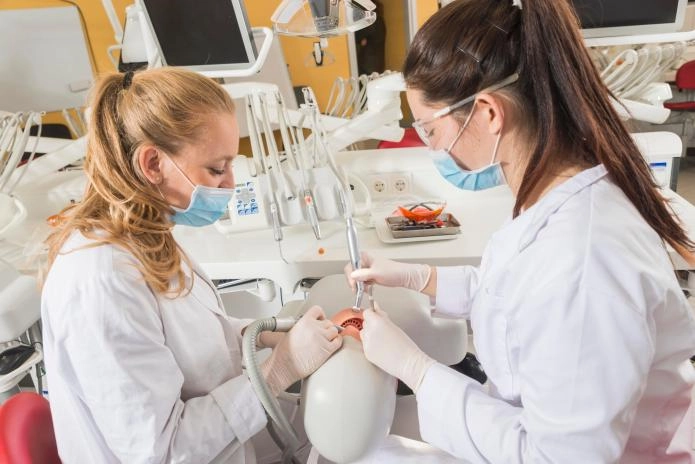
A 5-year long-cycle degree leading to a Doctor of Dental Surgery qualification, taught in English. Students begin hands-on practice with simulation dummies and 3D dental simulators from year one, alongside foundational subjects including anatomy, biochemistry, and microbiology.
RSU is one of the few schools in Europe that offers dentistry entry without a separate entrance exam. The degree is fully EU-accredited and recognised internationally.
-
Duration
5 years
-
Credits
300 ECTS
-
Tuition
€15,500 / year
-
Language
English
Teaching approach
Early clinical training
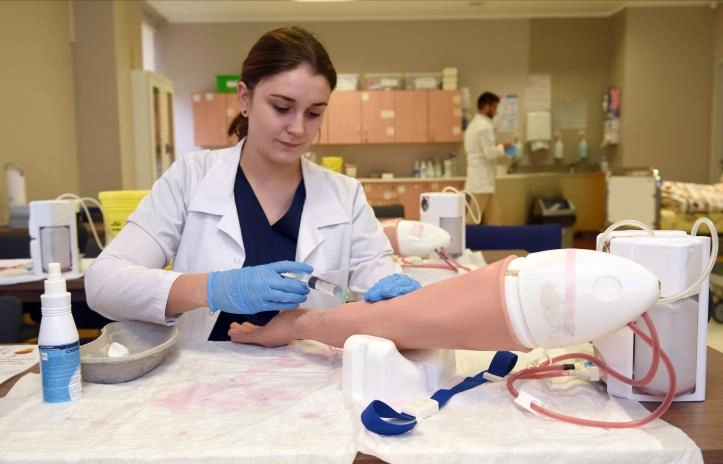
RSU students start building clinical skills from year two through the Medical Education Technology Centre (METC). The centre is equipped with patient simulators, specialist training dummies, and procedural tools for practising suturing, injections, and clinical communication.
By the time students enter real hospital placements, they arrive with practical preparation that makes a genuine difference.
Small classes and varied teaching methods
Class sizes at RSU are deliberately kept small: 13 students per teacher in medicine, and 8 in dentistry. Teaching goes beyond lectures, combining workshops, case studies, clinical rotations, and simulation training throughout the program.
Entry requirements and application
academic requirements
RSU does not require a separate entrance exam, which sets it apart from many medical schools in Western Europe. Admission is based on your academic record, specifically your high school diploma and performance in relevant subjects. Strong grades in biology, chemistry, and English are essential. Both subjects should ideally be studied to a high level, and a minimum grade of 4 (or equivalent in your country’s grading system) is expected.
Documents required
Applications typically require an academic transcript, a high school diploma, proof of English proficiency (IELTS, TOEFL, or equivalent), a motivation letter, and two reference letters from teachers. Requirements may vary slightly depending on your nationality, and Beyond Abroad’s team can help you confirm exactly what you need before applying.
Life in Riga: what to expect
Affordable and easy to settle into
Riga is one of the EU’s most affordable capital cities. Students can expect to spend €500 to €800 per month on living costs, covering accommodation, food, and transport.
Housing options include university hostels, private apartments, and shared housing. Compared to most European capitals, accommodation in Riga is easy to find and reasonably priced.
A genuinely international campus
With over 3,000 international students from 60+ countries on campus, English is the working language both in and out of the classroom. Students from Germany, Sweden, Finland, and Norway make up the largest international groups, making RSU one of the most diverse medical schools in Northern Europe.
Well connected to the rest of Europe
Latvia is an EU and Schengen member. Daily flights connect Riga to major European cities, making weekend travel across the continent straightforward and affordable throughout your studies.
Scholarships
RSU offers limited scholarships and tuition fee discounts based on academic performance. They are competitive and awarded based on results. Applying early with a strong academic record gives you the best chance.
Ready to study medicine or dentistry in Latvia? Apply to Riga Stradiņš University through Beyond Abroad.